

 Available Robots and Drivers
In order to simulate and interact with a robot in Parametric Robot Control, you need to provide the robot type and the robot driver. Both refer to classes in the PRC.Library.dll, i.e. KUKA.KUKA_KR1000 constructs a KR1000 robot via PRC.Library.Robots.KUKA.KUKA_KR1000().
The driver sets the appropriate kinematic solvers to perform the simulation. A driver may generate robot code or provide a real-time interface.
Drivers#
KUKA.KSS_KRL_DriverUseSplineMotions setting it can optionally emit spline motion commands (SLIN/SPTP/SCIRC with the C_SPL approximation criterion) instead of LIN/PTP/CIRC – this requires KSS 8.3 or higher.
KUKA.KSS_IOB_DriverInteraction setting: Servoing streams the robot's current axis position as JSON over UDP to an external system whenever the simulation updates, and visualizes positions received back live; Path-Table takes each motion's absolute time from the metadata key TimeStamp (seconds) instead of computing timing from speed, and generates a time-stamped axis_recorder take file (JSON) as its code output instead of KRL.
KUKA.KSS_MXA_Driver
UR.UR_Driver
UR.UR_RT_Driver
ABB.ABB_RAPID_DriverIRCVersion setting targets the controller generation: IRC5 (save the generated module as .mod) or IRC7/OmniCore (default, save as .modx).
ABB.ABB_RWS_Driver
IGUS.IGUS_Driver
NEURA.NEURA_SIM_Driver
NEURA.NEURA_RT_Driver192.168.2.13) and executes/streams motions live, with configurable blending, follow-target mode, and feedback interval.
Supervisor.Supervisor_Driver
Experimental: Connection-only driver (formerly Generic.Generic_Driver): it does not control a robot, but registers a client with the server so it can read the variables of all connected machines (robots, IoT devices, dashboards) and write variables of its own. It pairs with the robot-less Supervisor.Supervisor_Device preset – which is also the fallback the server uses when a setup request contains no robot definition at all. The standard polling path returns the variables of all connected machines plus a machine inventory (IDs, name, model, driver, status), and the .NET client additionally provides QueryVariables() and GetMachineData(id, excludeGeometry) for lightweight machine monitoring – with geometry excluded, replies shrink to under 1 KB and can be polled at 30–60 Hz. Adding tasks is not supported, and no license is required.
Robots#
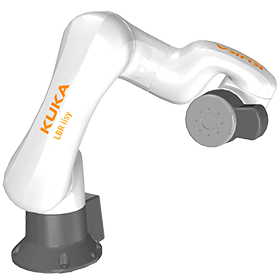
The following robots are currently integrated. They expand the robot library currently available in KUKA|prc.
KUKA.KUKA_KR1000
KUKA.KUKA_KR100120P2
KUKA.KUKA_KR10R1420
KUKA.KUKA_KR10R14402
KUKA.KUKA_KR120KR150R31002
KUKA.KUKA_KR120KR210R27002
KUKA.KUKA_KR120R1800
KUKA.KUKA_KR120R3900K
KUKA.KUKA_KR120R3900K2
KUKA.KUKA_KR125200
KUKA.KUKA_KR12KR20R1810
KUKA.KUKA_KR150240L110180
KUKA.KUKA_KR180KR240R29002
KUKA.KUKA_KR200comp
KUKA.KUKA_KR20R3100
KUKA.KUKA_KR210KR240R2700
KUKA.KUKA_KR210R31002
KUKA.KUKA_KR210R3300K
KUKA.KUKA_KR22R1610
KUKA.KUKA_KR250KR300R27002
KUKA.KUKA_KR3060
KUKA.KUKA_KR3070R2100
KUKA.KUKA_KR30L16
KUKA.KUKA_KR3605002
KUKA.KUKA_KR3R540
KUKA.KUKA_KR480R3330
KUKA.KUKA_KR4R600
KUKA.KUKA_KR50R2500
KUKA.KUKA_KR50R2500CRW
KUKA.KUKA_KR5arcHW
KUKA.KUKA_KR600R2830
KUKA.KUKA_KR610R1100
KUKA.KUKA_KR610R11002
KUKA.KUKA_KR610R900
KUKA.KUKA_KR610R9002
KUKA.KUKA_KR61620
KUKA.KUKA_KR616Arc
KUKA.KUKA_KR6R1820
KUKA.KUKA_KR6R18402
KUKA.KUKA_KR6R700
KUKA.KUKA_KR816R20102
KUKA.KUKA_KR8R1620
KUKA.KUKA_KR90KR120R2900
KUKA.KUKA_KR90KR150R3700K
KUKA.KUKA_KR90KR270R2500
KUKA.KUKA_KR90KR270R2700
KUKA.KUKA_KR90KR270R3100
KUKA.KUKA_LBR3R760
KUKA.KUKA_OALego
IGUS.IGUS_ReBel
Supervisor.Supervisor_Device (robot-less preset for machine monitoring – no kinematics, no geometry, no axes)
NEURA.NEURA_LARA_3
NEURA.NEURA_MAIRA_M
UR.UR_57e
UR.UR_10e
UR.UR_20
ABB.ABB_IRB6620
ABB.ABB_IRB6700_150_320
External Axes#
External axes are simulated alongside the robot; the simulation result contains their positions and out-of-range flags per interpolated step. Users of the .NET Client Library can instantiate ready-made presets from PRC.Library.ExternalAxes:
KUKA: KUKA_KL4000 (linear axis), KUKA_KP1V (KP1V500 single rotary axis), KUKA_DKP400 (2-axis positioner), KUKA_DKP500 (DKP500-2 HW 2-axis positioner), KUKA_KP2HV500 (KP2 HV500 2-axis positioner)
NEURA: MAV500 (MAV-500 AGV)
Note that over raw gRPC, external axes travel as full ExternalAxis definitions (type, kinematics, geometry) – there is no preset class string on the wire.
Driver-Specific Settings#
The settings dictionary returned by SetupRobot is driver-specific – always inspect the returned keys rather than hard-coding them. Notable keys that affect the generated output:
| Driver | Key | Values | Effect |
|---|---|---|---|
KUKA.KSS_KRL_Driver (and derived KSS_IOB) | UseSplineMotions | True / False (default) | Emits SLIN/SPTP/SCIRC instead of LIN/PTP/CIRC; approximated motions use C_SPL. Requires KSS 8.3+. |
ABB.ABB_RAPID_Driver | IRCVersion | IRC5 / IRC7/OmniCore (default) | Targets the controller generation; save the generated module as .mod (IRC5) or .modx (OmniCore). |
KUKA.KSS_KRL_Driver, ABB.ABB_RAPID_Driver, ABB.ABB_RWS_Driver | StatusTurn (Initial Posture) | None / 110 (default) / 010 / … | Posture of the forced initial PTP that is injected when a program starts with a Cartesian motion. None skips only the forced-posture PTP – the start axis motion is kept, the posture follows implicitly from it, and the simulation derives its posture from the start position via forward kinematics. Can lead to simulation/robot differences near singular start positions. |
KUKA.KSS_IOB_Driver | Interaction | Path-Table (default) / Servoing | Selects the IO Builder interaction mode (time-stamped take file vs. UDP position streaming). |
KUKA.KSS_IOB_Driver | PathSmoothing | Spline (default) / Linear | Smooths the simulation with cubic splines through the programmed targets while still reaching every target at its exact time. |
Generated Code & File Extensions#
When saving the code output of a simulation to disk, choose the file extension based on the driver:
| Driver | Output | Extension |
|---|---|---|
KUKA.KSS_KRL_Driver | KRL | .src |
UR.UR_Driver | UR program / URScript | .urpx (Polyscope X), .urp (Polyscope 5), .script (Script) – per the driver's Polyscope setting |
ABB.ABB_RAPID_Driver | RAPID | .mod (IRC5) / .modx (OmniCore) |
KUKA.KSS_IOB_Driver (Path-Table) | axis_recorder take file | .json |
NEURA.NEURA_SIM_Driver | Python (requires NeuraPy) | .py |